

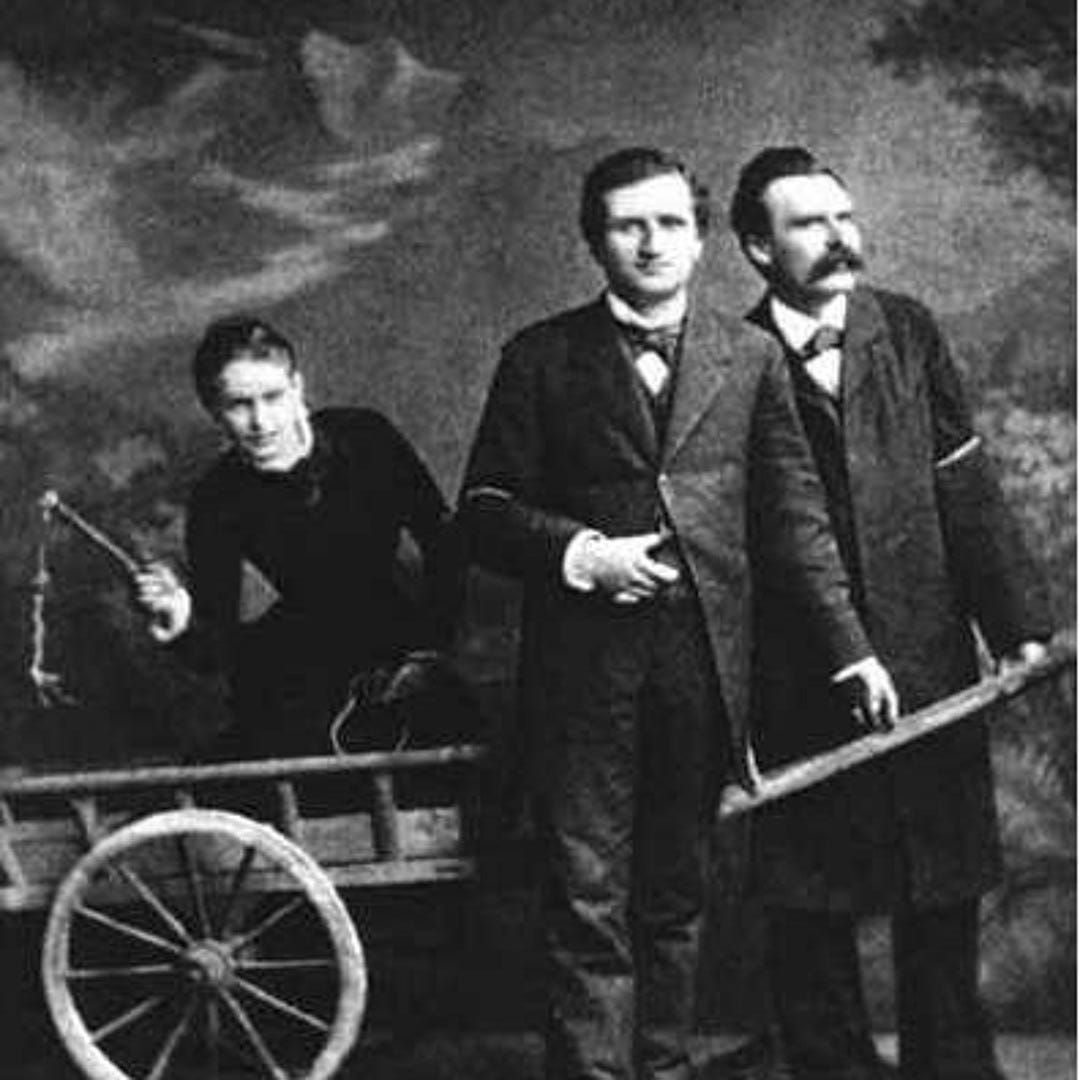
From left: Lou Salomé, Paul Rée, and Friedrich Nietzsche.
Walt Bismarck was not just vibe-surfing when he said, in a note a while back, that he’s the closest thing right now to what Nietzsche was in the 1880s (or something to that effect). He’s taken Nietzsche’s primary philosophical advances extremely seriously, and in the way Nietzsche hoped somebody would take them seriously, with just about exactly the type of outcome Nietzsche predicted that would have—the most rigorous departure from Kant’s universalizing moral and aesthetic philsophies that anybody’s managed since Kant made himself the seemingly inescapable substrate of those two fields back in the late 1700s.
At the very beginning of Beyond Good and Evil, Uncle Fred Neechee clowns on the idea of Cartesian mind-body dualism: “I think, therefore I am” is transparently senseless because there’s no “I” until it’s thought into being after-the-fact to account for preconscious impulses and actions that we’d like to imagine were actually principled decisions. But there has to be some other thing that impels actions and emotions before we think them in symbols like words and intuitive thought-forms—gotta have something to symbolize. “Maybe it’d be better to say, ‘It thinks, therefore I am,’” Nietzsche mused, before ending that section with the cryptic, “But who knows, maybe the new psychologist will even find a way to get rid of that little ‘it.’”
A few sections later (in #19, for those who wanna follow along and check my from-memory, therefore likely a bit off, translations), he comes back to it, trying to give his prophesied “new psychologist” a little more to work with: Before conscious thought retcons the self into being and tries to give it coherent motives and principles, there’s a preconscious “society of many souls” fighting it out inside, the somatic impulses of bones, organs, and muscles, all with their own tensions and tendencies.
They collide together and act before the conscious mind has even registered those impulses. After each bone’s, organ’s, and muscle’s maybe-conflicting impulse is aggregated together, their resultant vector—the stuff we do, the stuff we say without thinking—is the basis for our conscious minds’ later self-narration.
Nietzsche calls those preconscious impulses and basic, structural tensions “will.” For him, then, in chronological order, we have a biological structure in which parts of us compete to express their wills, then that structure in its social/ecological context (i.e. a body) acts according to its aggregate will, and finally symbolic consciousness comes in and interprets the expressions of that will into a self, into motives, into concepts, into narratives.
Later, Nietzsche decides that the primary form of that will is a “will to power,” which isn’t necessarily related to social or political power at all. It’s more like a reframing of what the Scot Catholic philosopher Duns Scotus woulda called “haecceity” (this-ness, the fundamental characteristic that makes a thing what it is) into an ecologically competitive model in which even the components of one person’s body are competing with the others, each to maximally express its own haecceity.
Then the result of that conflict is retrospectively interpreted as a self. Then, iterating the same process, people compete with each other to express their now interpretively consolidated wills and competitively interpret them against each other; then groups of people compete like that, and so on.
What Walt’s come to, now, with his Orange Book, is a systematization of how that works: He’s cast himself, I think convincingly, as Nietzsche’s prophesied “new psychologist,” or at least as one of them. (I’m guessing Freud, Jung, and Foucault each had some of that aspiration in them as well, and in any case each fulfilled it to a more limited degree, though none of ‘em really got out of Kant’s shadow and figured out a way to do morals and aesthetics without at least implicitly universalizing them.) So, instead of giving thoughts and notes about the new book via DM, as Walt invited, I’m gonna selectively annotate the thing as I read, kinda like how Georges Bataille did with The Will to Power in his book On Nietzsche.
Better to get notes from a reader who hasn’t had the chance to ask you what you meant (or, in something like Walt’s own terms, to see how your own hermeneutics migrate into another’s personal-ecological grammar matrix, which may well be largely contradictory to your own because of i) the Other Gap and ii) minimally overlapping ecological frames).
Also, though, and as a last note here: I imagine that this kind of thing is precisely why Walt published his book as a glossary of terms with painstakingly formal definitions. If he gave examples of each term, he’d be tempting readers to lump those examples into an intuitive pattern or type, which they could then retroactively stamp onto experiences as counterfeit replication of his theories.
But what he’s offering up aims to be an inductively founded manual for portable, personal deductive use, so it lets him know that his term or concept is replicable if a reader can personally make use of the formal definitions themselves and supply their own examples. I’m well aware that, if someone reads my annotations of some of those terms, that can supply that same skip-the-formal-and-foreground-the-intuition temptation, but that’s the danger in any experimental interpretation of somebody else’s theory.
Really I think that same problem is at the root of the current “replicability crisis” in psychology, as it was with such crises in, say, the nascent germ theory of disease when John Snow got mowed down by London’s miasma-loyalist doctors during the 1854 Broad Street cholera epidemic. A theory is experimentally formalized by one, then shared in formal terms. Then everybody else can measure it against their own prior idiological [sic] commitments and experiment with it, themselves, in widely varying degrees of good or bad faith.
I’ll organize this according to the sections in Walt’s book for ease of following it. His words, when quoted as a whole-definition block, are in italics. I’ll try to interpret in good faith as best I can. Don’t worry about the weird spacing in some of the quotations; something about copying and pasting from PDF and then moving it into Substack. I’ll debug as we go on.
1. Primitives:
Actor: The operative constituency of a hermeneutic; a locus of interpretation, conation,
memory, or action sufficiently persistent for one representation to bear upon another
through time. Requires enough felt continuity of self to accumulate experience, form
expectations, incur meaningful consequence, and allow earlier states to constrain later
ones. Requires neither a metaphysical soul nor internal unity; individuals, institutions,
coalitions, states, and systems all qualify where enough organized continuity exists for
prior information to alter subsequent behavior.
Use of “conation” here as opposed to French-theoryfied “desire” is telling and necessary, especially since it’s the center of what otherwise seems like an even list of four faculties. We can define that “conation” as something like the intersection of the words “desire,” “motive,” and “telos,” and it springs up all over the book.
It’s like a more already personalized and relatively diachronic (sustained over time through different contexts) version of what Nietzsche called “will”: Your goal-driven strategies and impulses, the wants stored up in you, even if they’re conflicting. Other philosophers/psychologists have separated out conation from conscious thought on one side and from emotion on the other as the middle of three registers of mental activity—not quite consciously and explicitly explainable, not quite unconscious and darkly fluid.
That is, an actor’s goal itself might be very sharply and consciously formulated, or it might not be, but in either case the personal consistencies of action, memory, and interpretation (note the plural “consistencies”) are still conative, and we can think of many of the status games later in the book as derivatives of that conation, as more-and-less conscious attempts by an actor both to fight toward a goal and to preserve the dignified coherence of the identity that relies on that goal.
Main upside of this definitional maneuver is that it allows us to talk about goal-driven acts, even deeply strategic ones developed over long terms, without implying that they’re necessarily conscious choices or preconscious vibe-pulses. Conation can just be recognized by its expressions.
Also significant to note the similarity, at least in terminology, to Bruno Latour’s “actor network” theory, where an “actor” is anything that exerts enough influence on a particular social and ecological network that it affects its function—so that, for Latour, a rock you tripped over is an actor because it influenced how bruised your toe is, which in turn influenced how you could act. Useful for a very general type of network analysis (especially the kind Latour was doing with his “hard science is socially constructed, too” lab studies back in the day).
Walt’s “actor” is not Bruno’s “actor,” though. Walt requires that the actor be mentally responsive and data-aggregative such that prior information alters subsequent behavior. Latour’s version that includes rocks and plants and stuff might be useful for mapping actions of a really complicated system whose function depends on non-social factors, like if you’re figuring out the relevant variables in preventing a runaway meltdown at a nuclear power plant and want to account for every bolt jutting from the floor as a potential saboteur. Walt’s version, though, is way more useful for figuring out people because, in the definition itself, he’s tied conation to the abilities to act in the world, remember that action, and interpret it.
What I mean is the definition itself renders actions, interpretations of them, and memories of both as subs to the grand dom, conation. It’s impossible to moralize about “honesty” or “authenticity” in that kind of framework, unless you’re banking on your hearers’ wishful tendencies to believe familiar and pleasant lies. So that framing lets Walt do away with most transcendently ethical questions—ain’t no categorical imperative here, only stronger or weaker imperatives that each desperately claim to be categorical.
That is, tere’s no universalizable right or wrong, here (and, thank baby Jesus, no performative phobia of seeming like a “relativist”). There are competing strategic programs, more and less conscious, whose enactors are incentivized to persuade others that some things are right, and some things are wrong. Ethics thus becomes a locally variable patchwork of social censure and incentive filters—a matter of charisma, not law, and most definitely not categorical law.
I’ve got an uneasy feeling, though, that this “actor” should be split further into acute and chronic versions—or what Walt might call synchronic actors and diachronic actors—so we can account for the fundamental social difference between when people adapt their conative actions, memories, and interpretations to the present social context and when they retain personal definition more ecologically independently—which Walt does get into in his talk, later, about “elasticity.”
But I think, here, those aren’t just quantitatively different things—this person can sustain a role for x seconds, and this person can sustain a role for x+n seconds—but qualitatively different. Practical example is the “not guilty by reason of insanity” concept: The idea is that this person is a diachronically legible actor who just happened to break into a socially unacceptable synchronic state, but their fundamental and normal state is the diachronic one, so that temporary lapse should be considered alien to the person.
Reminds me of how psychiatrists were called “alienists” around a hundred years ago, since the belief persisted that disordered psychological states were the result of intrusion by some kind of alien will, like a demonic possession, but which could be removed, allowing you to return to your normal diachronic-actor stable state. But all that gives much less weight to social context—what Walt’ll call “ecology”---than it seems a theory of social minds should if it wants to have predictive power.
//
Functionalist Nominalism: The ontological-epistemic view that categories aren’t Platonic
forms etched in the fabric of the cosmos but actor-authored compressions of recurrent
structure whose warrant consists in their functional purchase under causal exposure to
a world the actor did not author. Actors encounter a world that exceeds what their senses can register and minds can preserve, and so compress that world into portable linguistic handles that treat heterogeneous instances as sufficiently alike whenever doing so yields predictive, explanatory, or coordinative leverage. The world constrains the actor through consequence and the Writ of Nature, but he alone determines which distinctions are worth carrying forward. Functionalist Nominalism thus rejects both metaphysical essentialism and postmodern constructivism: categories are constructed without being arbitrary, fuzzy without being useless, and capable of carrying enormous information without their boundaries existing as metaphysical joints in nature.
Walt’s jousting with Carl Jung, here: Jung claimed that “complexes” were the forms that actors developed in their minds to respond to and explain personal experiences, and “archetypes” were species-universal collective patterns, not learned from any personal experience, that people reliably used as interpretive narratives for dimly felt unconscious events—the original, unlearned stencils through which the unconscious draws its pictures. Here, Walt’s collapsing what Jung would call “complexes” and “archetypes” into one word—”categories”—and ascribing them all to individual experience in social context and subsequent interpretation thereof.
Imagine Jung as the archetype of the holy roller in his grave: This is precisely what he warned against, that psychology can’t possibly have explanatory power as regards the unconscious if it restricts itself to the material experiences of the individual. It has to include a collective (like actually species-wide) unconscious to account for the existence of frequently repeated, culturally independent story-forms around the world and in particular people’s imaginations and dreams.
Walt departed from Nietzsche and Latour, in the definition of the actor, by restricting it to conative social actors. Here, he departs from Jung by replacing the collective unconscious with “recurrent structures” that “exceed what [our] senses can register,” so that easily compressible and understandable story-forms are a basic reaction to experience that would be expected to be shared widely among people who don’t share a culture because our biological and thus social forms are so similar across regions and races—although the details of these stories, and especially how they’re socially weighted and judged, vary about as much as something could vary.
In that way, his “functionalist nominalism” rejects “metaphysical essentialism”—by rejecting the idea of pre-given species-wide archetypes in favor of active and cognitive patterns that can be acquired through experience—and “postmodern constructivism,” since the functional patterns his actors internalize and act upon are particular to them and their experiences, even if shared, so they don’t feed into any generalizing claims to validity outside the particular social ecosystems those actors experienced.
That is, the concepts he wants to present are “functionalist” in that they need to have some explanatory and predictive power in new social contexts. They’re “nominalist” because they make no claim to metaphysical universality but are simply called-out, nominated, asserted, by individualized experience.
2. The Hermeneutics:
-The First Hermeneutic: A category earns warrant through what must be reconstructed
when it is removed; the resulting loss reveals its Functional Weight.
-The Second Hermeneutic: Memorable naming is itself epistemically useful when it makes diffuse structure cheaper to notice, remember, transmit, compare, and reuse while preserving information beyond the name’s memorability.
-The Third Hermeneutic: Every adjudication of a hermeneutic—including this one—exists inside its own hermeneutic grammar that decides what kind of object is present, which burdens attach, what counts as evidence, and what follows from satisfying those burdens.
The radiant gist: If some interpretation doesn’t change the way you have to think and act after you’ve come up with it, it doesn’t mean jack shit (i.e. has no “Functional Weight”). But any interpretation or context-to-context useful rule for interpretation is subject, itself, to the contexts where you develop and interpret it (and must thus vary in different times and places).
There are no first principles but the variability of social context and its unavoidable effect on precognitive machinations—though the shaping powers of “epistemic cheapness” (ease of understanding and applying an interpretive rule) and the assumed desire of an actor to maximize local legibility and status smell a little like first principles, too. In any case, there’s no metaphysically given order by which a statement might be given as an axiom that holds across all contexts and for all standards of evidence.
At bottom this can be looked at like a sociological restatement of Gödel’s old incompleteness theorems game: A logical system can’t be complete (i.e. able to answer any question you throw at it) and consistent (i.e. unable to contradict itself when addressing new contexts and questions) at the same time, since some questions are contextually self-contradicting in a way that requires astute social hand-rubbing and arched-eyebrow scheming.
The classic example: On Stub Island, there is one barber. The barber is a man. The barber shaves every man who doesn’t shave himself. Who shaves the barber?
The set-theory answer is there are two sets, {people shaved by barber=people who don’t shave themselves}, and {people not shaved by barber=people who do shave themselves}, but there’s no clean way of putting the barber himself into either of those two sets. If he shaves himself, he can’t be in the set of people shaved by the barber. If he doesn’t shave himself…then he has to shave himself. Schrödinger’s beard! It grows and shortens until you open the box and find out what the barber’s actually decided to do.
If you exit set theory and enter the social ecology of Stub Island, the barber shaves himself most of the time, since he’s def better at it than all these lazy shlubs who always let him shave them instead, but he’ll let somebody else shave him if he’s nearing retirement and vetting and training his replacements, or if he needs to secure the goodwill of some ornery neighbor who thinks he’s good with a razor and really wants to impress the venerable old barber.
More usefully, Walt’s tripartite hermeneutic (and especially the third one) is a sneaky lil’ route around Wittgenstein’s argument that a symbolic system can’t describe itself totally. If the interpretive schemes we carry around with us to parse apart social interactions can’t describe themselves, and, by extension, the ways we consciously interpret our actions and others’ don’t ground themselves in some master-interpretation (which, itself, would still need still another grounding interpretation), there must be some system of judgement outside symbolic consciousness where we interpret our word-symbols and gesture-symbols so that they make enough sense to us that we can keep using them and have some idea what we’re using and why.
The next Orange Annotations will drop in the next week or two. Let me know what you think—there’s a damn good chance I missed something important/misinterpreted something.